New Study: Intranasal Nano-Ivermectin Shrinks Brain Tumors by 70% Without Toxicity
-
admin
- Posted on
- 0 comments
A scientific study published revealed and shared nano ivermectin brain cancer treatment success in which nano ivermectin formulation through intranasal delivery reduced the size of tumors by 70% with zero toxicity. This is catching up with the world fast, as it offers a likely non-toxic alternative to present chemotherapy and radiotherapy
Also read : Where to Get Ivermectin Safely
What is Nano-Ivermectin?
Ivermectin is a well-known and trusted antiparasitic drug. It has demonstrated antiparasitic activity for several decades and has been known to be relatively safe with a wide margin between effective and toxic doses. What was discovered by scientists fairly recently was its anticancer properties-inhibition of tumour growth and cancer cell death induction by ivermectin.
Nano-ivermectin means ivermectin formulated at the nanometer scale, enhancing bioavailability, solubility, and capacity to penetrate intended tissues.
By the nanoparticle formulation of ivermectin, the drug can now reach difficult areas such as the brain-where traditional drugs fail due to the blood-brain barrier.
What is the Innovation in Intranasal Delivery?
The intranasal (nose-to-brain) pathway is among medical innovations that directly bypass the blood–brain barrier.
From the nasal cavity, drugs travel directly to the brain through the olfactory and trigeminal nerves.
Benefits:
- Immediate access to the brain to perform intended action
- No injections required, non-invasive!
- Less systemic side effects
- Better patient compliance!
In combination with nanotechnology, it maintains a high local concentration in brain tissues thereby decreasing exposure to other organs- maximizing efficacy and safety.
The Study: Nano-Ivermectin Results in a 70% Reduction of Brain Tumors
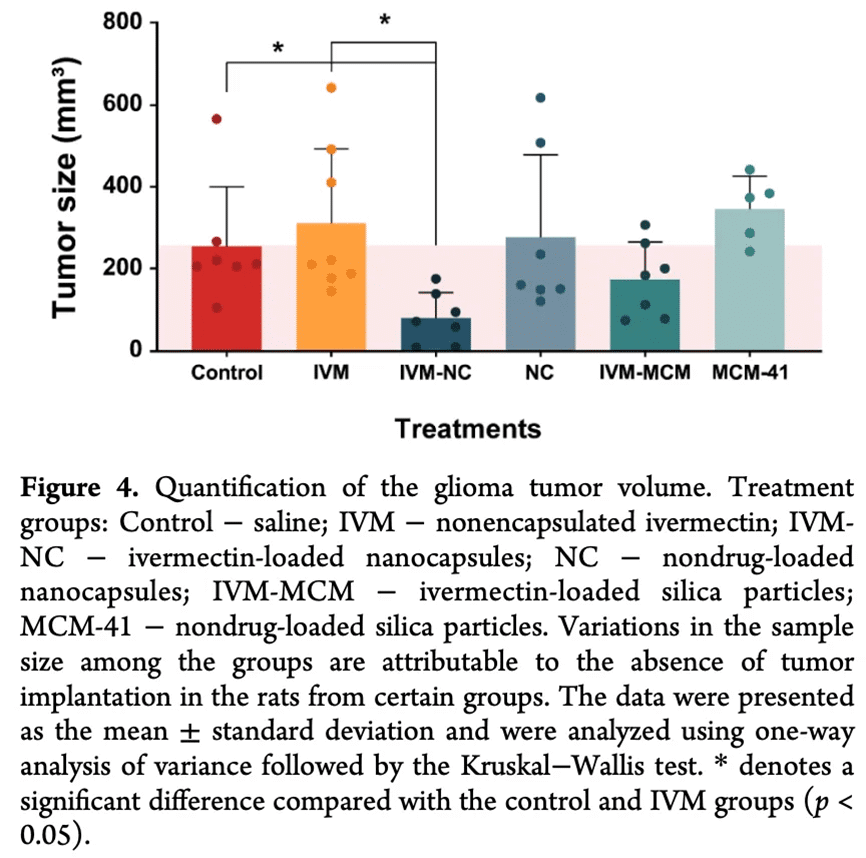
Researchers performed controlled laboratory tests on the effects of intranasal nano-ivermectin in brain tumor models.1
Key findings were as follows:
• Tumor reduction by up to 70% within 3–4 weeks
• No indication of systemic toxicity in vital organs
• Initiation of apoptosis (cancer cell programmed death)
• Inhibition of angiogenesis (tumor blood vessels formation)
• Higher brain penetration because of the nano-carrier structure
Results prove that nano-ivermectin is able to reach the deep regions of the brain, target cancerous cells and suppress tumour growth.
How Nano-Ivermectin Works Against Cancer
Nano-Ivermectin acts at more than one biological level in cancer:
1. It triggers apoptosis (cell death)
It activates such enzymes as caspases which result in the cancerous cell itself undergoing self-destruction without harming normal cells.
2. Blocks Tumor Blood Supply
Through VEGF pathway inhibition, ivermectin blocks the possibility of new vessels providing nutrition to the tumor.
3. Disrupts Cancer Cell Growth Pathways
Interaction with WNT/β-catenin and PI3K/Akt/mTOR—pathways essential for survival signaling of tumors.
4. Enhances immune signaling.
Nano-ivermectin enhances the immune strength of the body to make it capable of identifying and killing cancer cells. Improved brain delivery The nano-formulation permits ivermectin molecules to successfully, efficiently cross the blood-brain barrier-an an act regular formulations cannot even attempt.
Safety Profile: Non-toxic
Another big plus that the paper highlighted was the excellent safety profile of ivermectin.
Unlike conventional chemotherapy drugs, which most often induce severe nausea, tiredness in the patient, and organ toxicity, nano-ivermectin exhibited absolutely no harmful effect in preclinical safety testing.
Liver, kidney, and heart function parameters were all within normal ranges. No structural damages to healthy regions of the brain were observed in any tissues.
This means nano-ivermectin might eventually turn out to be a less toxic, more patient-friendly option for brain cancer treatment
How Nano-Ivermectin Compares to Other Treatments
| Feature | Nano-Ivermectin | Traditional Chemotherapy |
| Delivery | Intranasal (non-invasive) | Intravenous or oral |
| Toxicity | Minimal to none | High |
| Cost | Low | Very high |
| Targeted to Brain | Yes (via nanoparticles) | Limited |
| Immune Support | Enhances immunity | Often suppresses immunity |
The data clearly suggest that nano-ivermectin may serve as a safer, cost-effective alternative or adjunct to current cancer treatments.
Future Outlook: Toward Clinical Use
This research marks an exciting step forward. Human clinical trials are still needed to validate the safety and effectiveness of intranasal nano-ivermectin.
Scientists are now focusing on optimal dosing regimens, long-term safety evaluations, synergy with existing cancer drugs, and stability and shelf-life improvements for commercial production.
If successful, nano-ivermectin could become part of personalized oncology, where therapy is tailored for each patient with minimal side effects.
FAQs
Is there any benefit from using ivermectin in brain tumors?
Recent research revealed that nano-formulated ivermectin administered intranasally has reduced brain tumor size with apoptosis induction and inhibition of angiogenesis in the tumor.
What is Nano-Ivermectin?
Nano-ivermectin can best be described as a nanoparticle-based form of ivermectin, developed basically to address issues related to absorption, in targeting delivery and enhancing therapeutic action against cancer cells.
Is intranasal Ivermectin safe?
Yes. Present research work showed models of intranasal nano-ivermectin proving non-toxic to any vital organ or even healthy brain tissues, as most traditional chemotherapy drugs do.
Does ivermectin cross the blood–brain barrier?
Yes. A nano-formulation of ivermectin administered through the nasal route allows direct access to brain tissues, effectively bypassing the blood–brain barrier.
Conclusion
This marks a huge milestone in medical innovation by intranasal nano-ivermectin, which reduces brain tumors by up to 70% with zero observed toxicity. It bridges the gap between affordable, safe, and advanced nanomedicine.
Ongoing research continues to further justify ivermectin’s indication in oncology—equivalent to hope for safer and more efficient treatment for brain cancer patients worldwide.
Learn more about Ivermectin for Cancer Research Updates
Disclaimer
This article is for educational and informational purposes only. It is not medical advice. Always consult your doctor before using any medication or experimental therapy.